Written by: Sarah Mitchell, MCSP, MSc Physiotherapy — Chartered Physiotherapist, 12 Years Clinical Experience
Medically Reviewed by: Dr. James Ortega, MBBS, FRCS (Orth) — Consultant Orthopaedic Spine Surgeon
Last Updated: June 2025 | Next Review: June 2026
⚕️ Medical Disclaimer: This article offers general health information and does not replace advice from a qualified healthcare professional. Always consult your GP, physiotherapist, or call NHS 111 before starting any new exercise programme or if your symptoms worsen. Individual results vary based on diagnosis, age, and overall health.
🔑 Key Takeaways (15-Second Summary)
- Most common cause: Prolonged sitting and forward head posture strain the rhomboid and trapezius muscles.
- Fastest relief: Thread the Needle stretch, moist heat, and tennis-ball myofascial release.
- Red flags: Chest pressure, breathing difficulty, numbness in arms, or pain after a fall — call 999 or NHS 111.
- Recovery time: 2–4 weeks for muscular strains; book a physio appointment if pain lasts beyond 14 days.
- Prevention wins: Daily walks, mid-back strengthening twice weekly, and a correctly set-up workstation.
PAS Intro
That nagging ache between your shoulder blades won’t ease up. It ruins your concentration at work, disrupts your sleep, and makes every deep breath feel like a chore. This guide reveals exactly what triggers upper back pain, which stretches deliver genuine results, and the warning signs you must never ignore.
What Is Upper Back Pain? (Quick Symptom Check)
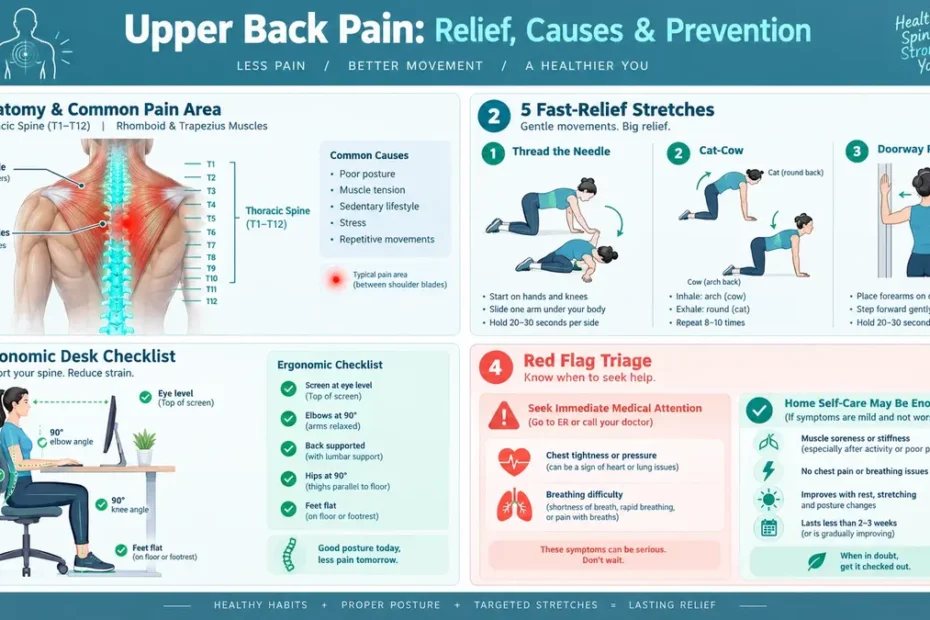
The thoracic spine stretches from the base of your neck to the bottom of your rib cage. This region contains twelve vertebrae (T1–T12) that anchor your ribs and shield vital organs.
Pain in this area often feels like a dull burn, a tight band, or a stabbing knot near the shoulder blades. The Cleveland Clinic reports that thoracic spine discomfort affects roughly 15–20% of adults each year.
Use this quick-check table to pinpoint your symptom pattern before reading further.
| Symptom | Likely Source | Urgency Level |
| Dull ache between shoulder blades | Muscle strain or poor posture | Low — self-care |
| Sharp pain when breathing deeply | Intercostal spasm or rib joint irritation | Moderate — monitor 48 hrs |
| Burning sensation wrapping around ribs | Thoracic radiculopathy or nerve compression | High — see your GP |
| Numbness or tingling in arms | Cervical or thoracic disc involvement | High — book urgent appointment |
| Pain after a fall or accident | Possible fracture or ligament tear | Emergency — attend A&E |
Most cases settle within two to four weeks with targeted movement and posture correction. Chronic episodes lasting beyond twelve weeks need a professional evaluation.
🔗 Related reading: Lower Back Pain Relief Guide | Postural Correction Exercises
7 Most Common Causes of Upper Back Pain
Identifying the root cause saves you from wasting time on the wrong fixes. Here are the seven triggers physiotherapists see most often in clinical practice.
1. Prolonged Sitting and Forward Head Posture
Staring at a laptop for eight hours pulls your head forward and rounds your shoulders. This posture overloads the rhomboid and middle trapezius muscles, creating stubborn trigger points between the scapulae.
2. Muscle Strain from Overuse
Lifting heavy boxes, rowing, or even carrying a toddler on one hip can strain the thoracic paraspinal muscles. Micro-tears in the muscle fibres produce localised soreness that worsens with movement.
3. Thoracic Kyphosis (Excessive Rounding)
An exaggerated outward curve of the thoracic spine compresses the facet joints and stretches the posterior ligaments. Over time, this structural shift produces persistent stiffness and fatigue.
4. Herniated or Bulging Thoracic Discs
Although less common than lumbar disc issues, a herniated disc in the mid-back can press on spinal nerves. This produces radiating pain that wraps around the chest or abdomen.
5. Osteoarthritis of the Facet Joints
Cartilage wear in the small joints connecting each vertebra leads to bone-on-bone friction. Morning stiffness that eases with gentle movement is a hallmark sign.
6. Scapular Dyskinesis (Abnormal Shoulder Blade Motion)
When the shoulder blade fails to glide smoothly along the rib cage during arm movement, surrounding muscles compensate and spasm. Swimmers and throwing athletes develop this pattern frequently.
7. Stress and Emotional Tension
Psychological stress triggers unconscious shoulder elevation. Hours of sustained muscle contraction restrict blood flow and produce lactic acid buildup, resulting in that familiar tight, knotted feeling.
A 2021 study in the Journal of Orthopaedic & Sports Physical Therapy found that postural stress and repetitive microtrauma account for nearly 68% of all thoracic spine complaints in working-age adults (NIH / PubMed, 2021).
Upper Back Pain Symptoms You Should Never Ignore
Mild soreness after a tough workout is normal. Certain red-flag symptoms, however, point to conditions that need immediate medical attention.
Watch for pain that radiates into the chest, jaw, or left arm. This pattern can mimic cardiac events and requires emergency assessment — call 999 straight away.
Unexplained weight loss paired with constant mid-back pain may signal an underlying systemic illness. Night pain that wakes you from sleep and does not improve with position changes also warrants urgent investigation.
The Mayo Clinic advises booking a GP appointment if your pain persists beyond two weeks despite rest and over-the-counter anti-inflammatories such as ibuprofen or paracetamol.
How to Relieve Upper Back Pain Fast at Home
You do not need expensive equipment to start feeling better today. These five strategies target the most common muscular and postural drivers of thoracic discomfort.
Apply Heat or Ice Strategically
Use ice for the first 48 hours after a sudden strain to reduce inflammation. Switch to moist heat after that window to relax tight muscles and improve blood flow.
Try Self-Myofascial Release
Place a tennis ball between your shoulder blade and a wall. Lean into the ball and roll slowly over tender spots for 60–90 seconds per side. This technique releases adhesions in the rhomboids and middle trapezius.
Practise Diaphragmatic Breathing
Shallow chest breathing keeps the accessory neck muscles overworked. Lie on your back, place one hand on your belly, and inhale deeply through your nose for four counts. Exhale slowly for six counts. Repeat ten cycles.
Take Micro-Breaks Every 30 Minutes
Set a phone timer. Stand up, squeeze your shoulder blades together for five seconds, and release. This simple reset prevents the sustained muscle loading that drives postural pain.
Use Topical Analgesics
Creams containing menthol or ibuprofen gel provide short-term relief by blocking local pain signals. Apply a thin layer to the affected area up to four times daily.
🔗 Also helpful: Best Office Chairs for Back Pain
5 Best Stretches for Upper Back Pain Relief
Perform these movements twice daily for the fastest results. Hold each stretch for 20–30 seconds and breathe steadily throughout.
| # | Stretch Name | Target Muscles | Difficulty | Duration |
| 1 | Thread the Needle | Rhomboids, thoracic rotators | Beginner | 30 sec/side |
| 2 | Cat-Cow | Entire thoracic spine, erectors | Beginner | 10 reps |
| 3 | Doorway Pec Stretch | Pectoralis major/minor, anterior deltoid | Beginner | 30 sec/side |
| 4 | Seated Thoracic Rotation | Obliques, multifidus, facet joints | Intermediate | 10 reps/side |
| 5 | Foam Roller Thoracic Extension | Thoracic extensors, latissimus dorsi | Intermediate | 60 sec |
Thread the Needle: Start on all fours. Slide your right arm under your left arm, lowering your right shoulder and temple to the floor. Hold. Switch sides.
Cat-Cow: On all fours, arch your back toward the ceiling (cat), then let your belly drop while lifting your chest (cow). Move slowly and match each phase to your breath.
Doorway Pec Stretch: Stand in a doorway with your forearms on the frame at shoulder height. Step one foot forward until you feel a gentle pull across your chest.
Seated Thoracic Rotation: Sit tall in a chair. Cross your arms over your chest and rotate your torso to the right, keeping your hips square. Return to centre and repeat on the left.
Foam Roller Extension: Lie with a foam roller placed horizontally across your mid-back. Support your head with your hands and gently arch over the roller. Avoid rolling onto the lower back.
Sleep Positions That Reduce Upper Back Pain Overnight
Your sleeping posture can either heal or aggravate thoracic tension. Side sleepers should hug a pillow to prevent the top shoulder from collapsing forward and twisting the spine.
Back sleepers benefit from a thin pillow under the knees and a cervical pillow that supports the natural neck curve. This alignment removes rotational stress from the thoracic segments.
Avoid stomach sleeping entirely. This position forces the neck into extreme rotation and flattens the thoracic curve, compressing the facet joints for hours at a time.
Ergonomic Desk Setup to Prevent Upper Back Pain
Your workstation geometry dictates how much strain your thoracic muscles absorb each day. Follow these evidence-based adjustments.
- Monitor height: Top of the screen at or slightly below eye level.
- Chair back: Lumbar support that maintains a slight inward curve in the lower spine, which indirectly unloads the thoracic region.
- Keyboard position: Elbows at 90 degrees, wrists neutral, shoulders relaxed — not shrugged.
- Feet: Flat on the floor or on a footrest. Dangling feet tilt the pelvis and round the mid-back.
- Desk height: Forearms parallel to the floor when typing.
Investing in a sit-stand desk lets you alternate positions every 30–60 minutes, which significantly reduces sustained postural loading on the thoracic spine.
Upper Back Pain vs. Neck Pain: Key Differences
Many people confuse cervical and thoracic pain because the regions overlap near the base of the neck. The distinction matters for treatment.
| Feature | Upper Back Pain | Neck Pain |
| Primary Location | Between shoulder blades, T1–T12 | Base of skull to C7 |
| Common Sensation | Dull ache, tightness, burning knot | Stiffness, sharp twinge, headache |
| Arm Involvement | Rare unless nerve root compressed | Common — tingling, numbness down arm |
| Aggravating Factor | Prolonged sitting, deep breathing | Looking down at phone, awkward sleeping |
| Typical Duration | 2–4 weeks with self-care | 1–3 weeks with self-care |
If your pain radiates past the elbow or causes hand weakness, the source likely originates in the cervical spine rather than the thoracic region.
When Upper Back Pain Signals a Serious Condition
Most thoracic discomfort stems from muscles and joints. A small percentage of cases, however, involve organs or systemic disease that refer pain to the mid-back.
Cardiovascular: Aortic dissection can present as sudden, tearing pain between the shoulder blades. This is a life-threatening emergency — call 999 immediately.
Pulmonary: Pleurisy or a pulmonary embolism causes sharp pain that worsens with inhalation. Seek emergency care if you also experience shortness of breath.
Gastrointestinal: Gallbladder inflammation often refers pain to the right shoulder blade. Pancreatitis can produce a boring pain that radiates straight through to the mid-back.
Oncologic: Persistent, unrelenting pain that worsens at night and does not respond to position changes may indicate a spinal tumour. This pattern demands immediate imaging.
Medical Treatments for Chronic Upper Back Pain
When conservative measures fail after six to eight weeks, your GP may recommend escalating treatment.
Physiotherapy: A chartered physio designs a progressive programme targeting thoracic mobility, scapular stabilisation, and deep cervical flexor endurance. Most patients attend two to three sessions per week for six to eight weeks.
Prescription Medications: Muscle relaxants like diazepam or short courses of oral corticosteroids can break the pain-spasm cycle. Your doctor will weigh benefits against side effects.
Trigger Point Injections: A physician injects a local anaesthetic directly into a palpable muscle knot. Relief often lasts four to six weeks and pairs well with physiotherapy.
Cognitive Behavioural Therapy (CBT): Chronic pain rewires the nervous system to amplify signals. CBT helps patients reframe pain perception and reduce fear-avoidance behaviours that prolong disability.
Surgical Options: Surgery for thoracic pain is rare. Procedures such as thoracic discectomy or spinal fusion are reserved for cases involving progressive neurological deficits or structural instability.
Upper Back Pain Prevention: Daily Habits That Work
Prevention costs far less effort than rehabilitation. Build these five habits into your daily routine.
- Walk 30 minutes daily. Walking promotes blood flow to the thoracic paraspinal muscles and maintains disc hydration.
- Strengthen your mid-back twice weekly. Rows, face pulls, and reverse flyes build the muscular endurance your posture demands.
- Limit phone scrolling. Hold your phone at eye level instead of dropping your chin to your chest.
- Hydrate adequately. Dehydrated discs and fascia lose elasticity, becoming more vulnerable to strain.
- Schedule annual posture screenings. A physio can identify movement imbalances before they become painful.
Frequently Asked Questions About Upper Back Pain
Q1: How long does upper back pain usually last?
Most acute episodes resolve within two to four weeks with rest, gentle stretching, and posture correction. Pain lasting beyond twelve weeks is classified as chronic and needs professional evaluation from your GP or physiotherapist.
Q2: Can stress cause upper back pain?
Yes. Emotional stress triggers sustained elevation of the shoulders, overworking the upper trapezius and levator scapulae muscles. This tension restricts blood flow and produces painful trigger points between the shoulder blades.
Q3: Is upper back pain a sign of a heart attack?
It can be. Sudden, crushing pain between the shoulder blades — especially when paired with chest pressure, shortness of breath, or jaw pain — may indicate a cardiac event. Call 999 immediately.
Q4: What is the best sleeping position for upper back pain?
Sleeping on your back with a supportive cervical pillow and a small pillow under your knees maintains neutral spinal alignment. Side sleeping with a pillow hugged to your chest is the next best option.
Q5: Should I use heat or ice for upper back pain?
Apply ice for the first 48 hours after a sudden injury to reduce swelling. After that, switch to moist heat to relax tight muscles and improve circulation. Alternating both often helps if you find relief from contrast therapy.
Q6: Can a chiropractor or osteopath help with upper back pain?
Spinal manipulation performed by a registered practitioner may provide short-term relief for joint-related thoracic pain. Research supports pairing manipulation with exercise for the best long-term outcomes. Always verify GCC or GOsC registration and discuss your full medical history first.
Take Control of Your Upper Back Pain Today
You now have a clear roadmap to identify, relieve, and prevent thoracic discomfort. Start with the five stretches above, fix your desk setup this afternoon, and commit to a daily 30-minute walk.
If your pain persists beyond two weeks or matches any red-flag symptoms listed in this guide, book an appointment with a chartered physiotherapist or your GP. Early intervention prevents minor strains from becoming chronic problems.
Your next step: Save this page, share it with a colleague who constantly rubs their shoulders, and try the Thread the Needle stretch right now. Your thoracic spine will thank you tomorrow morning.
📚 References (Primary Medical Sources)
- Cleveland Clinic. “Upper Back Pain: Causes, Symptoms & Treatment.” 2024.
🔗 https://my.clevelandclinic.org/health/diseases/upper-back-pain - National Institutes of Health / PubMed. “Prevalence and Risk Factors of Thoracic Spine Pain in Working Adults.” Journal of Orthopaedic & Sports Physical Therapy, 2021.
🔗 https://pubmed.ncbi.nlm.nih.gov/33411612/ - Mayo Clinic. “Back Pain: Symptoms and Causes.” 2024.
🔗 https://www.mayoclinic.org/diseases-conditions/back-pain/symptoms-causes/syc-20369906