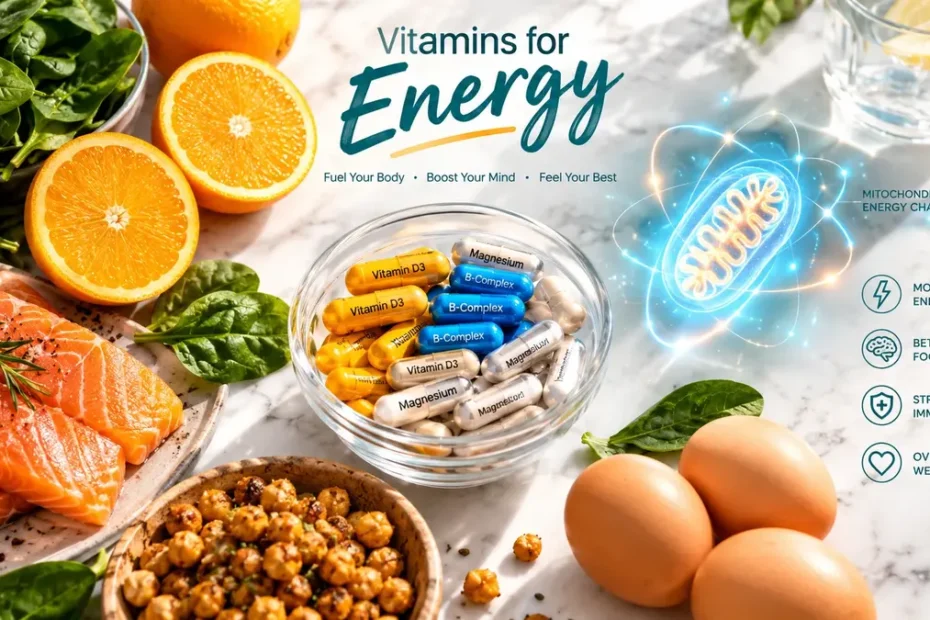
You drag yourself out of bed every morning, yet exhaustion follows you through the entire day. Coffee stops working. Naps leave you groggy. The real problem might sit inside your cells — a quiet nutrient gap draining your power. The right vitamins for energy can close that gap and hand you back the spark you lost.
Table of Contents
- What Vitamins Are Good for Energy and Why Your Body Craves Them
- B Vitamins for Energy: The Powerhouse Behind Cellular Fuel
- What Vitamins Should I Take for Energy If I Feel Tired All the Time
- Best Vitamins for Energy and Depression: The Mood-Vitality Connection
- Vitamins for Energy for Women: Addressing Hormonal Fatigue
- What Are the Best Vitamins for Energy According to Current Research
- What Vitamins Do I Need for Energy at Different Ages
- Vitamins for Energy and Tiredness: Whole Foods vs. Supplements
- What Vitamins Can I Take for Energy Without Side Effects
- How Long Before Vitamins for Energy Actually Start Working
- Common Mistakes People Make When Choosing Energy Supplements
- Frequently Asked Questions
What Vitamins Are Good for Energy and Why Your Body Craves Them
Quick Answer: The most effective vitamins for energy include the full B-complex family, vitamin D3, vitamin C, and iron-supporting cofactors — each playing a direct role in converting food into cellular fuel your body can actually use.
Your body runs on a microscopic furnace called the mitochondria. These tiny structures inside every cell convert food into usable fuel. When you lack specific nutrients, that furnace sputters and stalls.
Thirteen essential vitamins play distinct roles in this energy pipeline. B-complex vitamins carry the heaviest load because they act as coenzymes that unlock calories from carbohydrates, fats, and proteins.
Vitamin D, vitamin C, and iron-supporting nutrients also keep the engine humming. A deficiency in even one of these can trigger persistent tiredness that no amount of sleep fixes.
The National Institutes of Health Office of Dietary Supplements confirms that subclinical nutrient shortfalls affect millions of adults who eat seemingly balanced diets. You may not feel sick, but your energy pays the price.
B Vitamins for Energy: The Powerhouse Behind Cellular Fuel
Quick Answer: B vitamins for energy directly govern ATP production — the molecule your cells use as fuel — with B12, B6, folate, and thiamine playing the most critical roles in converting food into usable power.
B vitamins for energy deserve their own spotlight because they govern nearly every metabolic reaction in your body. Without them, your cells literally cannot produce ATP — the molecule your body uses as currency for every movement, thought, and heartbeat.
Complete B-Vitamin Energy Breakdown
| B Vitamin | Common Name | Energy Function | Daily Adult Requirement | Top Food Sources |
| B1 | Thiamine | Converts glucose into ATP | 1.1–1.2 mg | Pork, sunflower seeds, lentils |
| B2 | Riboflavin | Supports electron transport chain | 1.1–1.3 mg | Eggs, almonds, spinach |
| B3 | Niacin | Drives NAD/NADH energy cycles | 14–16 mg | Chicken breast, tuna, peanuts |
| B5 | Pantothenic Acid | Synthesizes Coenzyme A | 5 mg | Avocado, mushrooms, yogurt |
| B6 | Pyridoxine | Aids amino acid metabolism | 1.3–1.7 mg | Chickpeas, salmon, bananas |
| B7 | Biotin | Breaks down fatty acids | 30 mcg | Egg yolks, sweet potatoes |
| B9 | Folate | Supports red blood cell formation | 400 mcg | Dark leafy greens, asparagus |
| B12 | Cobalamin | Maintains nerve and blood cell health | 2.4 mcg | Clams, beef liver, nutritional yeast |
Why B12 Deserves Extra Attention
Vitamin B12 stands out because your body stores it in the liver for years. Once those reserves dip, fatigue hits hard and fast. Vegetarians and older adults face the highest risk of B12 depletion.
Symptoms of low B12 mimic general tiredness, making it easy to overlook. Tingling fingers, memory lapses, and a sore tongue often accompany the exhaustion.
What Vitamins Should I Take for Energy If I Feel Tired All the Time
Quick Answer: The vitamins for energy you need depend on your fatigue pattern — morning brain fog often signals low B12 or iron, afternoon crashes point to magnesium gaps, and all-day exhaustion frequently traces to vitamin D deficiency.
Chronic tiredness has many faces. You might struggle to focus at 2 p.m., wake up unrefreshed, or feel physically heavy after light activity. Pinpointing the right vitamins for energy and tiredness starts with understanding your specific fatigue pattern.
Matching Your Fatigue Type to the Right Nutrient
- Morning heaviness with brain fog often points to low B12 or iron
- Afternoon crashes frequently trace back to unstable blood sugar tied to magnesium and chromium gaps
- All-day exhaustion may signal vitamin D deficiency, especially during winter months
A simple blood panel ordered by your doctor can reveal which nutrients fall short. Guessing leads to wasted money and delayed relief.
Harvard T.H. Chan School of Public Health recommends testing before supplementing to avoid masking underlying conditions like thyroid dysfunction or anemia.
Best Vitamins for Energy and Depression: The Mood-Vitality Connection
Quick Answer: The best vitamins for energy and depression include vitamin D3, B6, folate, and B12 — nutrients that directly support serotonin and dopamine production in the brain while fueling cellular energy pathways.
Fatigue and low mood travel together more often than people realize. When your brain lacks the raw materials to produce serotonin and dopamine, both your energy and your outlook suffer.
Key Mood-Energy Nutrients
- Vitamin D3 activates genes that release serotonin. Low levels correlate strongly with seasonal affective patterns.
- Vitamin B6 converts tryptophan into serotonin. Without enough B6, your brain literally cannot build the chemical that stabilizes mood.
- Folate (B9) supports methylation cycles that regulate mood-stabilizing neurotransmitters.
- Omega-3 fatty acids (not a vitamin, but critical) reduce brain inflammation linked to both depression and fatigue.
Mayo Clinic research shows that correcting a single B-vitamin deficiency can improve depressive symptoms within four to eight weeks in mild cases.
Always talk to a licensed mental health professional before replacing prescribed treatment with supplements. Vitamins support your brain; they do not replace therapy or medication when you need them.
Vitamins for Energy for Women: Addressing Hormonal Fatigue
Quick Answer: Women’s vitamins for energy must account for menstrual iron loss, pregnancy demands, and hormonal shifts — making iron, B12, folate, vitamin D3, and magnesium the most critical nutrients across every life stage.
Women face unique energy thieves that men rarely encounter. Menstrual blood loss drains iron stores monthly. Pregnancy and breastfeeding multiply nutrient demands. Perimenopause disrupts sleep architecture and thyroid function simultaneously.
Women’s Energy Needs by Life Stage
| Life Stage | Primary Energy Drain | Key Nutrients to Prioritize |
| Menstruating (18–45) | Iron loss, B12 depletion | Iron, B12, Folate, Vitamin C |
| Pregnancy | Rapid cell division, blood volume expansion | Folate, Iron, DHA, Choline |
| Postpartum | Sleep deprivation, nutrient depletion | Vitamin D, B-complex, Magnesium |
| Perimenopause (40–55) | Hormonal fluctuation, thyroid slowdown | Vitamin D3, B6, Magnesium, Iodine |
| Postmenopause (55+) | Bone density loss, metabolic slowdown | Calcium, D3, K2, B12 |
Iron deficiency remains the number one cause of fatigue in women under 50 worldwide. Pairing iron-rich foods with vitamin C dramatically improves absorption. Squeeze lemon over spinach or drink orange juice with your morning eggs.
What Are the Best Vitamins for Energy According to Current Research
Quick Answer: The best vitamins for energy backed by clinical research are vitamin B12, vitamin D3, and iron for deficient individuals, with magnesium, CoQ10, and creatine showing moderate supporting evidence for fatigue reduction.
Science moves fast, and supplement marketing moves faster. Stripping away the hype leaves a short list of nutrients with strong clinical backing for fatigue reduction.
Evidence-Tiered Supplement Guide
Tier 1 — Strongest Evidence:
- Vitamin B12 (especially for deficient individuals)
- Vitamin D3 (for those with levels below 30 ng/mL)
- Iron (only when ferritin is low)
Tier 2 — Moderate Evidence:
- Magnesium glycinate (improves sleep quality and muscle recovery)
- Coenzyme Q10 (supports mitochondrial ATP output)
- Creatine monohydrate (boosts cellular energy in brain and muscle)
Tier 3 — Emerging Evidence:
- Rhodiola rosea (adaptogen that reduces perceived fatigue)
- Alpha-lipoic acid (antioxidant that recycles other vitamins)
Notice that “energy blends” with 30 ingredients rarely appear in peer-reviewed journals. Simplicity wins. Fix the deficiency first, then experiment with extras.
What Vitamins Do I Need for Energy at Different Ages
Quick Answer: Your vitamins for energy shift with age — younger adults need B-complex and vitamin D, midlife adults benefit from added B12 and iron, and older adults require sublingual B12 and higher D3 doses due to declining absorption.
Your nutrient requirements shift as your body ages. A 25-year-old athlete and a 65-year-old retiree need very different strategies.
Age-Specific Energy Vitamin Guide
| Age Group | Metabolic Reality | Priority Vitamins for Energy |
| 18–30 | Peak metabolism, high activity | B-complex, Vitamin D, Magnesium |
| 31–45 | Stress accumulation, hormonal shifts | B12, Iron, Vitamin D3, Folate |
| 46–60 | Slowing metabolism, absorption decline | B12, D3, CoQ10, Magnesium |
| 60+ | Reduced stomach acid, medication interactions | B12 (sublingual), D3, K2, Iron (if deficient) |
After age 50, stomach acid production drops significantly. This makes absorbing B12 from food much harder. Sublingual tablets or injections bypass the gut entirely and deliver the vitamin straight into your bloodstream.
Vitamins for Energy and Tiredness: Whole Foods vs. Supplements
Quick Answer: Whole foods deliver vitamins for energy in synergistic packages your body absorbs efficiently, while supplements fill specific gaps that diet alone cannot cover — the best approach combines both strategically.
Pills are convenient, but food delivers nutrients in synergistic packages your body recognizes instantly. An orange gives you vitamin C, fiber, flavonoids, and water all at once. A tablet gives you ascorbic acid and a binder.
Top Energy-Dense Foods to Build Your Plate Around
- Eggs — B12, choline, and complete protein in one shell
- Salmon — Omega-3s, B6, B12, and vitamin D
- Spinach — Iron, folate, and magnesium
- Sweet potatoes — B6, vitamin A, and complex carbohydrates
- Greek yogurt — B2, B12, and probiotics for gut absorption
Supplements fill the gaps that food cannot cover. Geographic location, dietary restrictions, and medical conditions create legitimate reasons to reach for a bottle. Just do not let a multivitamin replace a meal.
What Vitamins Can I Take for Energy Without Side Effects
Quick Answer: The safest vitamins for energy include water-soluble B-complex and vitamin C at standard doses, plus vitamin D3 at 1,000–2,000 IU daily — avoid mega-dosing fat-soluble vitamins without medical supervision.
Safety matters. More is not better when it comes to fat-soluble vitamins. Your body stores vitamins A, D, E, and K in liver and fat tissue. Overdosing can cause toxicity that mimics the very fatigue you want to cure.
Water-soluble vitamins like B-complex and C carry lower risk because your kidneys flush excess amounts. Still, mega-doses of B6 above 100 mg daily can cause nerve damage over time.
Safe Starting Doses for Most Adults
- Vitamin D3: 1,000–2,000 IU daily
- B-complex: one standard capsule at the recommended daily value
- Magnesium glycinate: 200–400 mg before bed
- Iron: only under medical supervision (excess iron damages organs)
Always read labels. Many “energy” supplements secretly pack 5,000% of the daily value for B vitamins. Your body simply urinates the surplus, turning your bathroom visits neon yellow and your wallet lighter.
How Long Before Vitamins for Energy Actually Start Working
Quick Answer: Most vitamins for energy begin showing results within two to eight weeks depending on deficiency severity — B-complex works fastest at one to three weeks, while vitamin D and iron may require two to six months.
Patience tests everyone. You swallow a capsule on Monday and expect rocket fuel by Tuesday. Biology does not work that way.
Realistic Timelines Based on Deficiency Severity
| Nutrient | Mild Deficiency | Severe Deficiency |
| Vitamin B12 | 2–4 weeks | 2–3 months |
| Vitamin D3 | 4–8 weeks | 3–6 months |
| Iron | 3–6 weeks | 3–6 months |
| Magnesium | 1–2 weeks | 4–8 weeks |
| B-complex (general) | 1–3 weeks | 4–6 weeks |
Consistency beats intensity. Taking your supplements at the same time every day builds steady blood levels. Skipping days resets the clock and keeps you stuck in the fatigue loop.
Common Mistakes People Make When Choosing Energy Supplements
The supplement aisle overwhelms even informed shoppers. Avoid these traps that waste money and delay results:
- Buying “proprietary blends” that hide individual dosages behind vague labels
- Taking iron with calcium — calcium blocks iron absorption by up to 60%
- Ignoring timing — fat-soluble vitamins need a meal with dietary fat for absorption
- Stacking too many products — overlapping ingredients create accidental mega-doses
- Skipping bloodwork — supplementing blindly treats symptoms you may not have
Start with one or two targeted nutrients based on lab results. Add more only after you see measurable improvement or your doctor recommends it.
Frequently Asked Questions About Vitamins for Energy
What vitamins for energy work the fastest?
B-complex vitamins, especially B12, typically produce noticeable energy improvements within one to three weeks if you have a deficiency. Magnesium can improve sleep-related fatigue even faster, often within days.
What vitamins to take for energy if I am a vegetarian?
Prioritize B12 (found almost exclusively in animal products), iron from plant sources paired with vitamin C, and vitamin D3 from lichen-based supplements. Vegetarians face the highest risk for these three gaps.
Can vitamins for energy replace coffee?
No. Caffeine blocks adenosine receptors to mask tiredness temporarily. Vitamins for energy repair the underlying cellular machinery that produces fuel. Use both strategically — caffeine for short-term alertness, vitamins for long-term stamina.
What vitamins are best for energy during pregnancy?
Prenatal formulas containing folate (600–800 mcg), iron (27 mg), B12, and DHA cover the most critical needs. Always choose a prenatal vitamin approved by your obstetrician rather than a generic energy supplement.
What vitamins do I need for energy if I already eat well?
Even clean eaters often fall short on vitamin D (especially above 37° latitude), B12 (if you limit red meat), and magnesium (soil depletion reduces crop content). A targeted blood test reveals your personal blind spots.
What vitamins can I take for energy alongside prescription medications?
This depends entirely on your specific medications. Blood thinners interact with vitamin K. Thyroid medications conflict with iron and calcium. Ask your pharmacist or doctor before combining any supplement with prescription drugs.
Take Back Your Energy Starting Today
Your body wants to feel alive. It wants to wake up ready, push through the afternoon, and still have gas left for the people and projects you love. The gap between where you are and where you want to be might be smaller than you think — a handful of targeted nutrients, a simple blood test, and the patience to let biology do its work.
Stop guessing. Book a nutrient panel with your doctor this week. Identify your specific deficiencies. Then choose one or two high-quality supplements that match your actual needs. Your future self — the one who wakes up without hitting snooze four times — will thank you.
Your energy is not gone. It is just waiting for the right fuel.
Medical Disclaimer: This article provides general educational information only and does not constitute medical advice, diagnosis, or treatment. Always consult a qualified healthcare professional before starting any supplement regimen, especially if you are pregnant, nursing, taking medications, or managing a chronic health condition. Individual nutrient needs vary based on age, sex, medical history, and lifestyle. The author and publisher accept no liability for actions taken based on the content of this page.
Written by: Sarah Mitchell, MS, RDN — Registered Dietitian Nutritionist with 12 years of clinical experience in metabolic health and micronutrient therapy.
Medically Reviewed by: Dr. James Ortega, MD, FACP — Board-Certified Internal Medicine Physician specializing in nutritional biochemistry and fatigue disorders.
Last Updated: June 2025